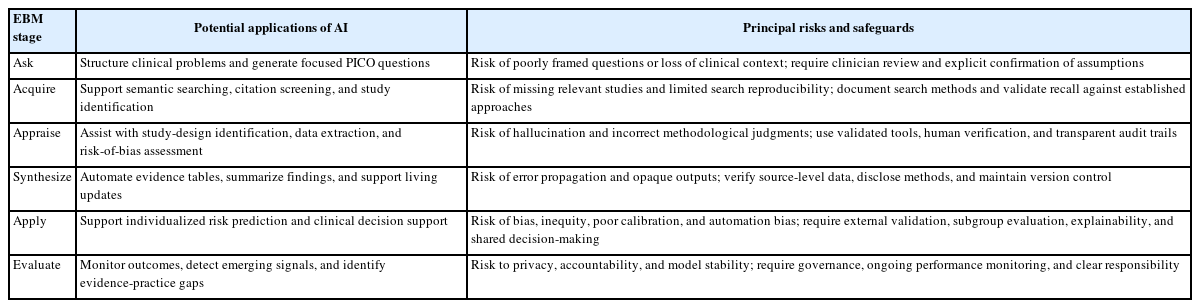
Evidence-based medicine (EBM) has transformed clinical decision-making by integrating the best available research evidence with clinical expertise and patients’ values and preferences. Over the past three decades, EBM has evolved from the critical appraisal of individual studies into a broader framework encompassing evidence synthesis, clinical practice guidelines, assessment of evidence certainty, research transparency, and shared decision-making. Despite these advances, contemporary EBM faces important challenges, including the rapidly increasing volume of research, delays in evidence synthesis and implementation, limited applicability of randomized controlled trials to heterogeneous real-world populations, and difficulties in individualizing population-level evidence. Emerging approaches—including real-world evidence, living evidence, learning health systems, precision medicine, and artificial intelligence (AI)—offer opportunities to address these limitations. Together, these approaches may enable a transition from static to continuously updated evidence, from population-average to more personalized evidence, and from a linear evidence pipeline to a learning evidence ecosystem in which clinical practice both uses and generates evidence. AI may further accelerate evidence retrieval, synthesis, updating, and individualized decision support, while introducing challenges related to reliability, bias, transparency, reproducibility, and accountability. Next-generation EBM should therefore be conceptualized not as a replacement for traditional EBM but as its evolution into a digitally connected, continuously learning evidence ecosystem. In the AI era, the foundational principles of EBM—source verification, critical appraisal, uncertainty assessment, integration of patient preferences, and accountable human judgment—will become increasingly important.



 First
First Prev
Prev