


• KSEBM
  • Contact us
  • E-Submission
ABOUT
BROWSE ARTICLES
EDITORIAL POLICY
FOR CONTRIBUTORS

Page Path

2
results for

"Preprint"

Filter

Article category

Keywords

Publication year

Authors

Funded articles

"Preprint"

Original Article

Evaluating regional diversity in scientific communication: a comparative analysis of COVID-19 preprints and peer-reviewed publications
Dong Hyun Kim, Kyulee Jeon, Seng Chan You
J Evid-Based Pract 2026;2(2):73-83.   Published online September 29, 2026
DOI: https://doi.org/10.63528/jebp.2026.00007
Background
The COVID-19 pandemic triggered extensive global research, leading to an unprecedented surge in both peer-reviewed publications and preprints. Despite their widespread use, the implications of preprints for global diversity in scientific communication remain underexplored. This study evaluates how preprints influenced regional diversity in COVID-19 research by analyzing international collaboration networks, social media engagement, and citation patterns compared to peer-reviewed publications.
Methods
We conducted a comparative analysis of COVID-19-related peer-reviewed publications indexed in SCOPUS and preprints from MedRxiv (December 2019–November 2022). Regional diversity was evaluated using bibliometric metrics stratified by World Bank income classifications and geographic regions. International collaboration was quantified using network analysis metrics, while publication, dissemination, and social media engagement were assessed through relative ratios. Social media engagement was measured by quoted posts on X (formerly Twitter). Citation counts were compared between articles with preprint history versus those published directly in journals.
Results
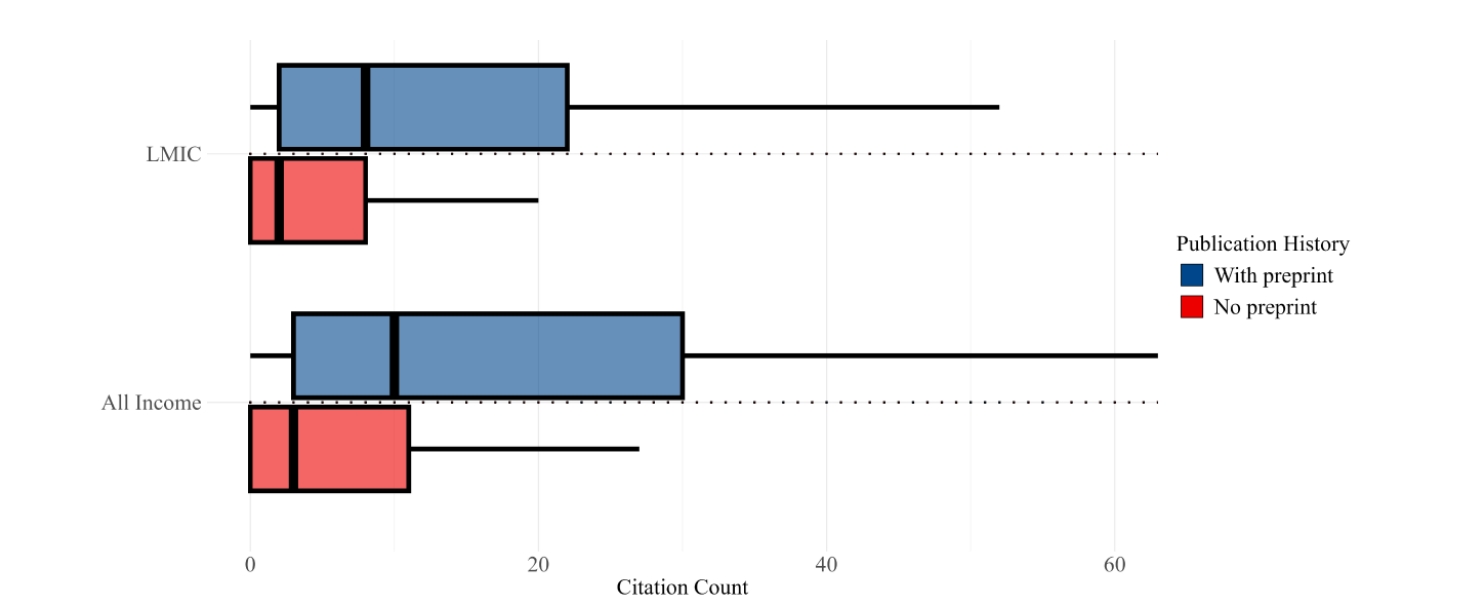
Authors from Sub-Saharan Africa, Latin America, and the Caribbean showed 3.9–4.5 times higher eigenvector centrality in preprints than in peer-reviewed papers, indicating greater integration into global research networks through preprint platforms. Low-income countries showed higher representation in preprints (P<0.001). Although overall engagement on X was similar for both formats, preprints exhibited higher relative ratios of quoted posts across all income groups. Peer-reviewed articles with preprint history received more citations (median=10, 25th-75th percentiles: 3–30) than those without (median=3, 25th-75th percentiles: 0–11, P<0.001), especially from low- and middle-income countries.
Conclusions
Preprints significantly advanced regional diversity in scientific communication during the COVID-19 pandemic. Preprints enhanced international collaboration networks, particularly benefiting researchers from lower-income regions, facilitated broader social media engagement across all income groups, and conferred meaningful citation advantages for subsequent peer-reviewed publications. These results suggest that preprints represent an important mechanism for promoting more equitable participation in global scientific discourse.
  • 33 View
  • 1 Download

Review

Beyond the paywall: the role of preprints in overcoming publication bias
Hyun Kang
J Evid-Based Pract 2025;1(1):7-11.   Published online March 31, 2025
DOI: https://doi.org/10.63528/jebp.2025.00002

Preprints have become a transformative tool in scientific communication, addressing critical challenges of traditional publishing, including long peer-review timelines, high costs, and systemic publication bias. Publication bias, which disproportionately favors studies with positive or statistically significant results, undermines the comprehensiveness and accuracy of the scientific record. By offering an open platform for sharing all research findings, preprints ensure that studies with null or negative results are also represented, mitigating the selective publication that skews research fields and meta-analyses. The COVID-19 pandemic highlighted the importance of preprints, as they facilitated the rapid dissemination of urgent findings while maintaining accessibility. Unlike traditional journals, preprints bypass lengthy review processes, enabling immediate access to data and fostering timely feedback, collaboration, and application. This inclusivity and transparency enhance trust in the research process while democratizing access to scientific knowledge. Despite their advantages, preprints face challenges, such as inconsistent quality standards, discrepancies between preprints and final publications, and risks associated with unverified findings. These challenges can complicate their use in systematic reviews and evidence-based medicine, requiring careful consideration and handling.This paper explores the interplay between preprints and publication bias, detailing how preprints can reduce bias while identifying limitations that must be addressed.

Citations

Citations to this article as recorded by  
  • Correcting what cannot be corrected: rethinking publication bias analysis methods in clinical meta-analyses
    Hyun Kang
    Korean Journal of Anesthesiology.2026; 79(3): 271.     CrossRef
  • Open Science Practices in Systematic Reviews From 2014 to 2024: A Cohort Study of 300 Systematic Reviews
    Kenneth Färnqvist, Patrik Karlsson, Vera Wachtmeister, Patrick Vallance, Emma Sinervo
    Cochrane Evidence Synthesis and Methods.2026;[Epub]     CrossRef
  • 2,195 View
  • 16 Download
  • 2 Crossref
TOP