Background Evidence-based medicine (EBM) is an important element of medical education. However, nationwide data on EBM education in Korean medical schools are limited. This study aimed to describe the organizational structure, content, methods, and assessment of EBM education, together with barriers and support needs, and to explore factors associated with variation across schools.
Methods A 26-item questionnaire was administered to EBM education leaders or course directors at 21 Korean medical schools. Data were analyzed descriptively, and differences by structural and exogenous characteristics were explored using cross-tabulation.
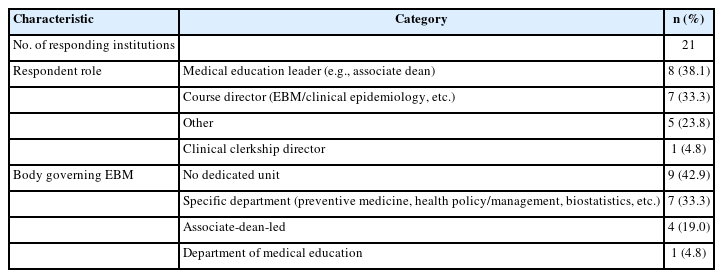
Results Twenty-one of 40 medical schools responded. All responding institutions offered EBM as a mandatory subject, but 42.9% had no dedicated organizing unit. Coverage of classic EBM steps was high (formulating clinical questions: 95.2%; literature searching: 95.2%; critical appraisal: 76.2%), whereas AI-assisted evidence summarization was included in only 19.0%. Only 19.0% reported systematic theory–clinical integration, and 57.1% left bedside EBM to preceptor discretion. Demand for a standardized curriculum guide (90.5%) and faculty development (76.2%) was high, and 100% were willing to use externally developed materials. Variation in key outcomes was associated with organizational governance but was not explained by exogenous structural characteristics such as class size, clinical infrastructure, establishment type, or region.
Conclusions EBM education in Korean medical schools is universally mandatory but uneven in organization, theory–clinical integration, faculty capacity, assessment, and AI integration. These differences appeared to reflect governance more than resource size, suggesting that society-level support should include organizational models alongside standardized curricula, assessment tools, and faculty development.
Background Modifiable risk factors account for a substantial proportion of dementia cases and represent important targets for prevention. However, previous studies have often focused on a limited range of risk factors and have rarely examined whether their associations with dementia differ according to sex and age at onset.
Objectives: To investigate sex- and age-specific associations between modifiable risk factors and incident Alzheimer's disease dementia using a nationwide population-based cohort in South Korea.
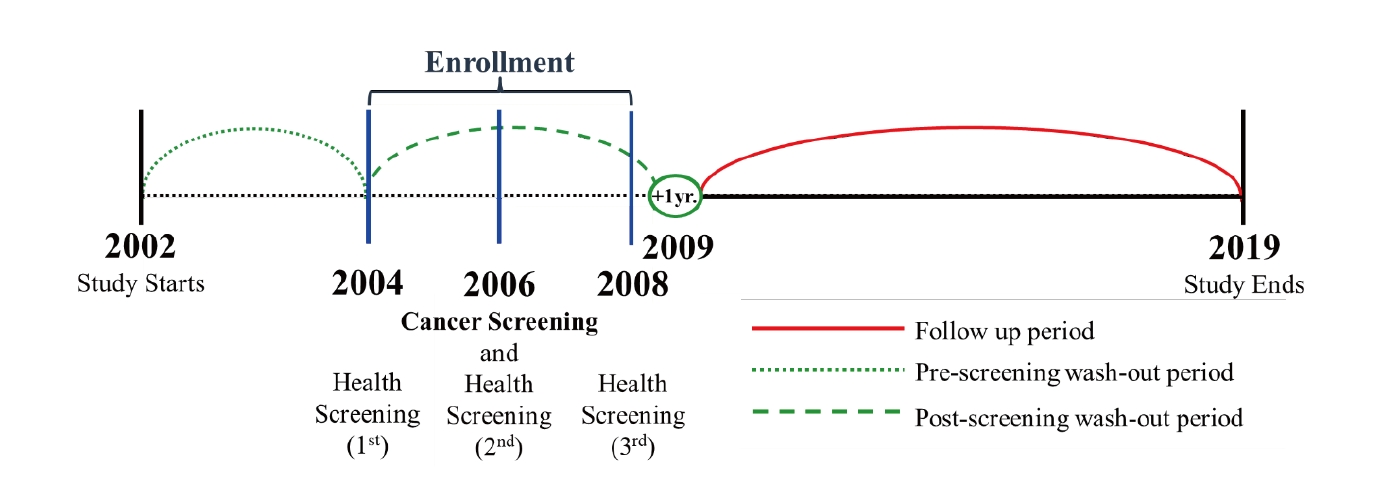
Methods We conducted a retrospective cohort study using the National Health Information Database of the Korean National Health Insurance Service. Among individuals who participated in the National Cancer Screening Program in 2006 and underwent general health examinations in 2004, 2006, and 2008, 599,306 adults aged 40–79 years were included. Participants were followed from 2010 to 2019 after applying pre- and post-screening washout periods. Incident Alzheimer's disease dementia was defined using ICD-10 codes F00 or G30. Cox proportional hazards regression models were used to estimate hazard ratios (HRs) and 95% confidence intervals (CIs). Analyses were stratified by sex and age group to distinguish early-onset Alzheimer's disease dementia (EOAD) and late-onset Alzheimer's disease dementia (LOAD). During the 10-year follow-up period, dementia risk profiles differed substantially according to sex and age at onset. Lower educational attainment was consistently associated with increased dementia risk across all groups. Current smoking and physical inactivity were significant risk factors for dementia in both sexes, whereas underweight status was associated with an increased risk of LOAD. Among chronic conditions, diabetes, hypertension, and depression elevated dementia risk, with depression demonstrating the strongest association, particularly for EOAD (males: HR = 3.61, 95% CI: 2.63–4.96; females: HR = 1.83, 95% CI: 1.46–2.29). Sensory and functional impairments, including hearing loss, visual loss, physical disability, and traumatic brain injury, were also associated with increased dementia risk, although the magnitude and significance of these associations varied by sex and age group. The predictive performance of the models was acceptable, with C-statistics ranging from 0.6784 to 0.7803.
Conclusions The associations between modifiable risk factors and incident Alzheimer's disease dementia exhibited distinct sex- and age-specific patterns. These findings highlight the importance of tailored dementia prevention strategies that account for differences in demographic characteristics and risk factor profiles. Targeted interventions addressing modifiable risk factors may contribute to reducing the future burden of dementia at both individual and population levels.



 First
First Prev
Prev