Background The COVID-19 pandemic triggered extensive global research, leading to an unprecedented surge in both peer-reviewed publications and preprints. Despite their widespread use, the implications of preprints for global diversity in scientific communication remain underexplored. This study evaluates how preprints influenced regional diversity in COVID-19 research by analyzing international collaboration networks, social media engagement, and citation patterns compared to peer-reviewed publications.
Methods We conducted a comparative analysis of COVID-19-related peer-reviewed publications indexed in SCOPUS and preprints from MedRxiv (December 2019–November 2022). Regional diversity was evaluated using bibliometric metrics stratified by World Bank income classifications and geographic regions. International collaboration was quantified using network analysis metrics, while publication, dissemination, and social media engagement were assessed through relative ratios. Social media engagement was measured by quoted posts on X (formerly Twitter). Citation counts were compared between articles with preprint history versus those published directly in journals.
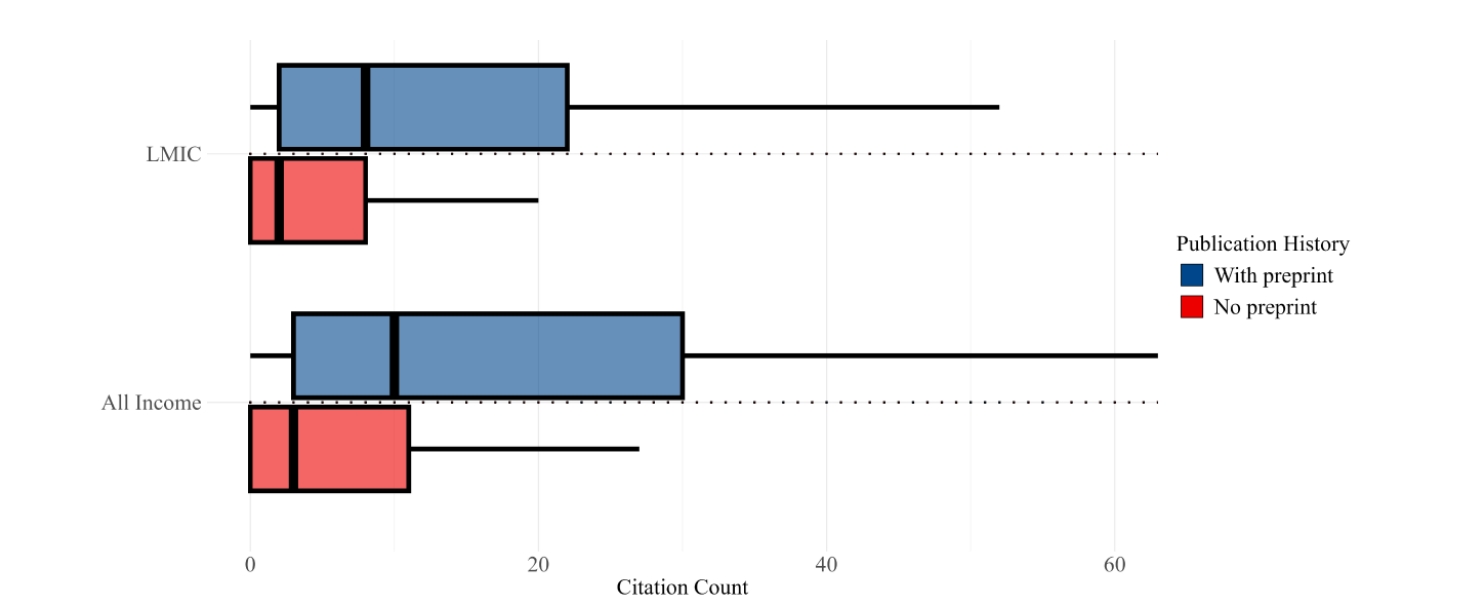
Results Authors from Sub-Saharan Africa, Latin America, and the Caribbean showed 3.9–4.5 times higher eigenvector centrality in preprints than in peer-reviewed papers, indicating greater integration into global research networks through preprint platforms. Low-income countries showed higher representation in preprints (P<0.001). Although overall engagement on X was similar for both formats, preprints exhibited higher relative ratios of quoted posts across all income groups. Peer-reviewed articles with preprint history received more citations (median=10, 25th-75th percentiles: 3–30) than those without (median=3, 25th-75th percentiles: 0–11, P<0.001), especially from low- and middle-income countries.
Conclusions Preprints significantly advanced regional diversity in scientific communication during the COVID-19 pandemic. Preprints enhanced international collaboration networks, particularly benefiting researchers from lower-income regions, facilitated broader social media engagement across all income groups, and conferred meaningful citation advantages for subsequent peer-reviewed publications. These results suggest that preprints represent an important mechanism for promoting more equitable participation in global scientific discourse.



 First
First Prev
Prev