


| Hyun Kang | 3 Articles |
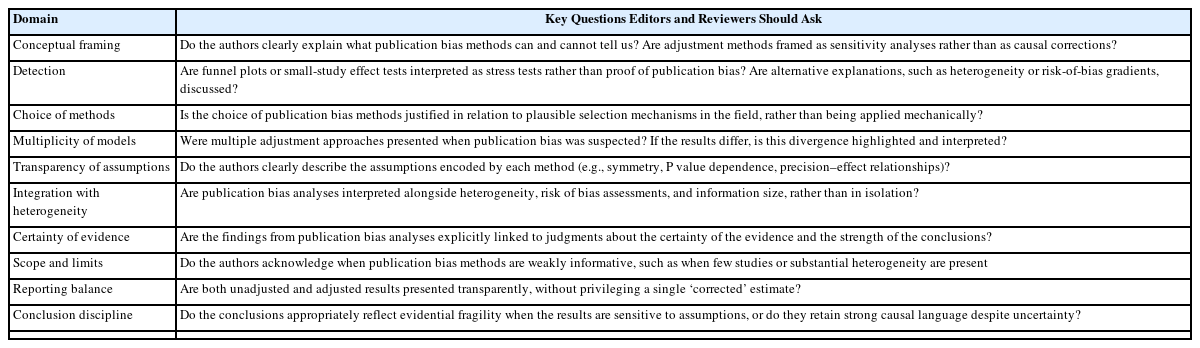
Publication bias is a fundamental threat to the validity of systematic reviews and meta-analyses in clinical medicine. Yet current practice often reduces its assessment to the mechanical application of funnel plots, asymmetry tests, or single adjustment procedures, with limited attention to the underlying assumptions, alternative explanations, or implications for evidence certainty. This narrative methodological article reframes publication bias assessment as an interpretive and editorial responsibility rather than a purely technical problem. We examine what commonly used methods can and cannot reliably support. Detection tools function as nonspecific stress tests that identify deviations from simplified models; they do not diagnose selective publication but highlight situations in which the underlying assumptions require closer inspection. Adjustment approaches, including trim-and-fill, selection models, and regression-based methods, generate hypothetical estimates under unverifiable assumptions**, and therefore provide** sensitivity analyses rather than corrections that recover the true underlying effect. Divergence across adjustment methods is particularly informative, signaling inferential fragility rather than analytical failure. We identify five recurring misinterpretations encountered in peer review: equating asymmetry with proof of publication bias; privileging bias-adjusted estimates as inherently more credible; relying on a single adjustment method without examining assumption dependence; ignoring the plausibility of adjustment direction and magnitude; and overlooking implications for certainty of evidence. Editors and reviewers should prioritize transparency of assumptions, seriously consider alternative explanations, and calibrate conclusions proportionately. Viewing publication bias assessment as an interpretive responsibility rather than a methodological checklist promotes more disciplined inference and strengthens trust in clinical evidence synthesis.
Preprints have become a transformative tool in scientific communication, addressing critical challenges of traditional publishing, including long peer-review timelines, high costs, and systemic publication bias. Publication bias, which disproportionately favors studies with positive or statistically significant results, undermines the comprehensiveness and accuracy of the scientific record. By offering an open platform for sharing all research findings, preprints ensure that studies with null or negative results are also represented, mitigating the selective publication that skews research fields and meta-analyses. The COVID-19 pandemic highlighted the importance of preprints, as they facilitated the rapid dissemination of urgent findings while maintaining accessibility. Unlike traditional journals, preprints bypass lengthy review processes, enabling immediate access to data and fostering timely feedback, collaboration, and application. This inclusivity and transparency enhance trust in the research process while democratizing access to scientific knowledge. Despite their advantages, preprints face challenges, such as inconsistent quality standards, discrepancies between preprints and final publications, and risks associated with unverified findings. These challenges can complicate their use in systematic reviews and evidence-based medicine, requiring careful consideration and handling.This paper explores the interplay between preprints and publication bias, detailing how preprints can reduce bias while identifying limitations that must be addressed. Citations Citations to this article as recorded by

|
|